Estimating sampling and laboratory capacity for a simulated African swine fever outbreak in the United States
Abstract
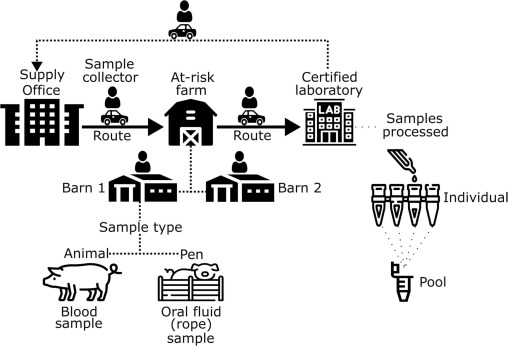
The introduction of African swine fever virus (ASFV) into uninfected countries can significantly impact economic and animal welfare, making rapid detection and control crucial for successful eradication and business continuity. This study describes a model developed to determine the necessary resources following an ASFV introduction into the U.S. The study simulated ASFV spread in a densely populated swine state, generating a median of 27 (range = 1-68) outbreaks over 150 days. This resulted in 616 (range = 1-15,011) sampling events, with a total of 3068 (range = 7-69,118) barns sampled. Researchers calculated the total number of sample collectors needed, considering daily working hours, sampling, driving time, and laboratory capabilities with and without blood sample pooling. Samples included 31 blood samples and five oral fluid samples per barn, equating to 84,830 and 14,195 blood and oral fluid samples, respectively. The median number of sample collectors required to prevent sampling delays ranged from 136 to 367, increasing to between 833 and 3115 in the worst epidemic scenarios. Excluding downtime for samplers could reduce the number of required collectors by 28% to 75%, while switching from blood to oral fluid samples could reduce this number by 47% to 75%. With a daily laboratory processing capacity of 1000 samples, the median processing time without pooling was 92 days, potentially extending to 5.7 years. The study indicated a need to redistribute a median of 10,062 unprocessed samples daily to other laboratories to prevent delays. This research aims to address the challenges of efficiently organizing resources for a potential ASFV outbreak, providing critical information on the sample collectors and laboratory capacity required for a swine-dense region in the U.S.