Identifying control strategies to eliminate African swine fever in the United States swine industry in under 12 months
Abstract
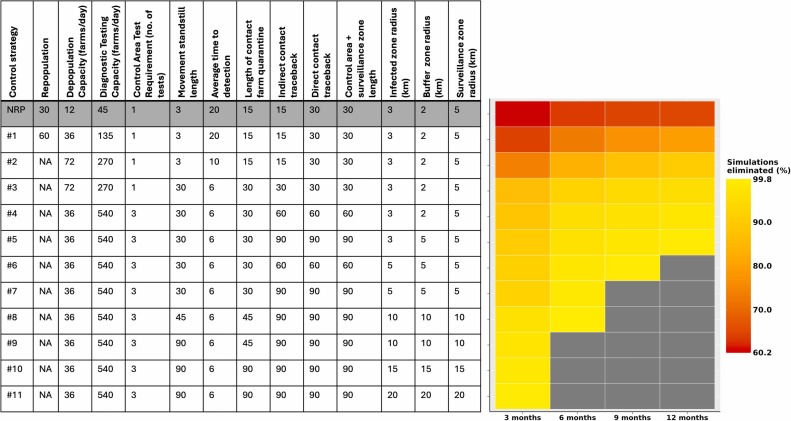
abstract: “With the rising risk of African swine fever (ASF) introduction into the U.S., there is substantial emphasis on preparation for an epidemic to mitigate the economic impacts observed in previous outbreaks. Mathematical models represent a vital tool for simulating future epidemics and examining the effectiveness of response strategies. This study expands on the current National Response Plan (NRP) for ASF and evaluates its effectiveness in eliminating ASF in swine populations in the southeast U.S. in three, six, nine, and twelve months. We achieved this by incrementally increasing the intensity of the control actions: i) quarantine and depopulation; ii) a 72-hour standstill; iii) contact tracing; and iv) control areas (composed of infected zones (3 km), buffer zones (2 km), and surveillance zones (5 km)), which include routine diagnostic testing, pre-permit testing, and movement restrictions. Our results demonstrate that under the NRP, only 65.1% of simulations in our study area were eliminated in a 12-month time frame. Through the analysis of 11 different scenarios, we propose that a future ASF control strategy would need to: i) increase radii and duration of control areas and surveillance zones; ii) extend the traceback and quarantine for contact farms; iii) extend the movement standstill; iv) prohibit repopulation of depopulated farms; and v) achieve quicker baseline detection of ASF, to eliminate ASF within the target timeframes.”