Analyzing the intrastate and interstate swine movement network in the United States
Abstract
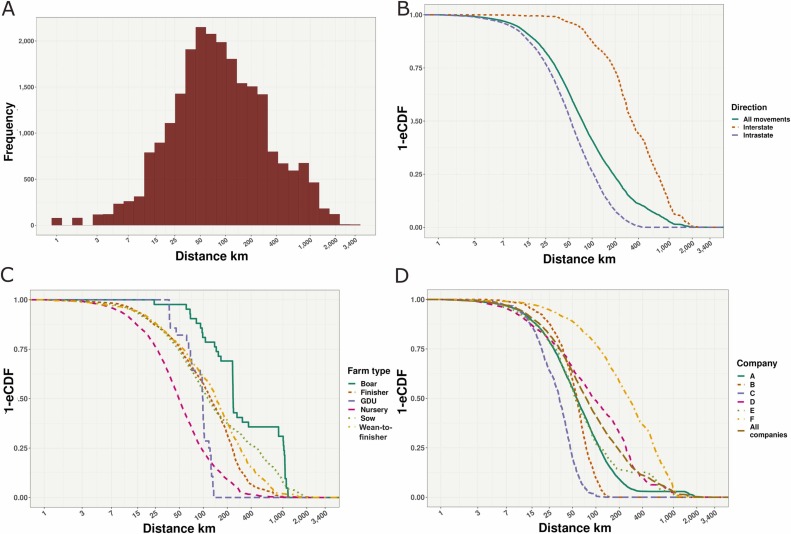
Identifying and restricting animal movements is a common approach used to mitigate the spread of diseases between premises in livestock systems. Therefore, it is essential to uncover between-premises movement dynamics, including shipment distances and network-based control strategies. This study analyzed three years of between-premises pig movements, encompassing 197,022 unique animal shipments, 3,973 premises, and 391,625,374 pigs shipped across 20 U.S. states. Researchers constructed unweighted, directed, temporal networks at 180-day intervals to calculate premises-to-premises movement distances, the size of connected components, network loyalty, and degree distributions. Based on outgoing contact chains, network-based control actions were identified. The results showed that the median distance for pig movements between premises was 74.37 km, with median intrastate and interstate movements being 52.71 km and 328.76 km, respectively. On average, 2,842 premises were connected via 6,705 edges, forming a weak giant connected component that included 91% of the premises. The premises-level network exhibited loyalty, with a median of 0.65 (IQR: 0.45 – 0.77). The study highlights the effectiveness of node targeting to reduce the risk of disease spread, demonstrating that targeting 25% of farms with the highest degree or betweenness limited spread to 1.23% and 1.7% of premises, respectively. Although complete shipment data for the entire U.S. is not available, this multi-state movement analysis underscores the value and necessity of such data for enhancing the design and implementation of proactive disease control tactics.