Coupling spatial statistics with social network analysis to estimate distinct risk areas of disease circulation to improve risk-based surveillance
Abstract
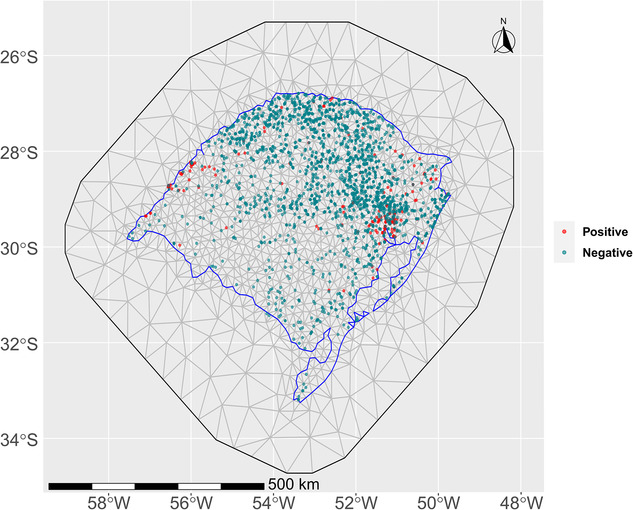
Most animal disease surveillance systems concentrate efforts in blocking transmission pathways and tracing back infected contacts while not considering the risk of transporting animals into areas with elevated disease risk. Here, we use a suite of spatial statistics and social network analysis to characterize animal movement among areas with an estimated distinct risk of disease circulation to ultimately enhance surveillance activities. Our model utilized equine infectious anemia virus (EIAV) outbreaks, between-farm horse movements, and spatial landscape data from 2015 through 2017. We related EIAV occurrence and the movement of horses between farms with climate variables that promote local disease propagation. A spatially explicit model was developed to account for the non-stationary effect of climate variables on EIAV occurrence. Ultimately, integrating animal movement data with spatial risk mapping can inform decisions regarding animal movement permits, potentially reducing the reintroduction of infections into low-risk areas.