Assessing epidemiological parameters and dissemination characteristics of the 2000 and 2001 foot-and-mouth disease outbreaks in Rio Grande do Sul, Brazil
Abstract
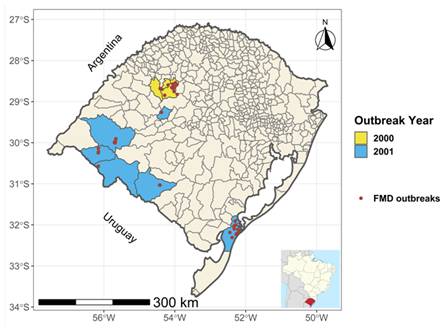
Since 1998, the state of Rio Grande do Sul, Brazil, has been free of foot-and-mouth disease (FMD) with yearly mandatory vaccination until the 2000 and 2001 FMD reintroductions. This study gathered data from both outbreaks from official veterinary state service archives and field investigation reports to quantify epidemiological parameters such as epidemic duration and the number of secondarily infected farms and animals, which are necessary for estimating outbreak dynamics parameters. We applied a Bayesian latent variable approach to estimate the time-varying reproduction number R t at animal level and calculated the number of newly confirmed cases by infection date. Our results demonstrated that for 2000 outbreaks, with 22 infected farms, the median R t was just above one, while 2001 outbreaks exhibited a R t of 1.6, which would explain the wider spread of infection among the 30 infected farms. Our findings not only provide key FMD transmission parameters and highlight the main epidemiological differences between epidemics but also emphasize the practical implications for Brazil’s preparedness for future FMD outbreaks, including potential surveillance approaches and guidance for producers. Furthermore, this study demonstrated how high-quality epidemic data can be used to reconstruct past outbreaks contributing to post-epidemic preparedness.