Foot-and-mouth disease in Bolivia: simulation-based assessment of control strategies and vaccination requirements
Abstract
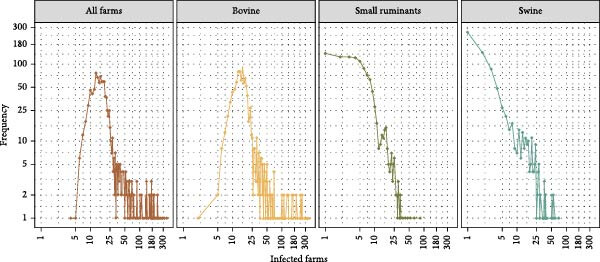
Examining the dissemination dynamics of foot-and-mouth disease (FMD) is crucial for revising national response plans. This study developed a stochastic susceptible-exposed-infected-recovered (SEIR) metapopulation model to simulate FMD outbreaks in Bolivia and explore how the national response plan impacts dissemination among all susceptible species. The research explored variations in control strategies, mapped high-risk areas, and estimated the number of vaccinated animals required during reactive ring vaccination. Initial outbreaks in the simulations ranged from 1 to 357 infected farms, with control measures implemented for up to 100 days, including control zones, a 30-day movement ban, depopulation, and ring vaccination. Combining vaccination (50–90 farms/day) and depopulation (1–2 farms/day) controlled 60.3% of outbreaks. When depopulation rates were higher (3–5 farms/day) with similar vaccination, 62.9% of outbreaks were controlled, and they were eliminated 9 days faster. Depopulation alone controlled 56.76% of outbreaks but resulted in a significantly longer median duration of 63 days. The most effective approach identified was combining vaccination (25–45 farms/day) and depopulation (6–7 farms/day), which eliminated all outbreaks within a median of 3 days. In contrast, vaccination alone controlled only 0.6% of outbreaks and had a median duration of 98 days. The results indicate that the most effective strategy involves ring vaccination combined with depopulation, requiring a median of 925,338 animals to be vaccinated. Outbreaks were most frequent in high-density farming areas such as Potosí, Cochabamba, and La Paz. The study concludes that emergency ring vaccination alone cannot eliminate FMD if reintroduced in Bolivia, and combining depopulation with vaccination significantly shortens the outbreak duration.