A CFD-informed barn-level swine disease dissemination model and its use for ventilation optimization
Abstract
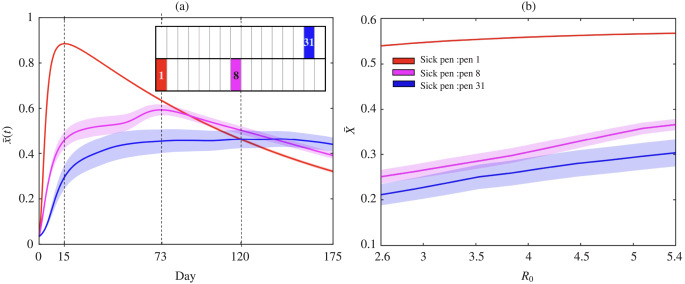
The airborne spread of infectious livestock diseases significantly contributes to epidemics, especially in densely populated facilities like commercial swine barns. This study introduces a framework to analyze airborne disease dissemination within these barns and to support the strategic design of control measures, including ventilation optimization and the strategic placement of sick animals (sick pen). The framework utilizes a susceptible-infected-recovered (SIR) model that accounts for disease spread between pens in swine barns. A pen-to-pen contact network is employed to build a transmission matrix based on the transport of airborne respiratory pathogens across pens, using a Reynolds-averaged Navier-Stokes computational fluid dynamics (CFD) solver. By applying this CFD-augmented SIR model, the researchers demonstrated that both the location of the sick pen and the barn’s ventilation configuration are critical in influencing disease dissemination dynamics at the barn level. The study also investigated the impact of natural ventilation through various curtain adjustments, observing that such adjustments could either suppress disease spread by an average of 64.8% or exacerbate outbreaks by an average of 5.8%, compared to scenarios without raised side curtains. Furthermore, the ventilation configuration was optimized by integrating the CFD-augmented framework with a genetic algorithm to select and place ventilation fans, aiming to minimize swine disease dissemination within barns. This optimized ventilation system led to a significant reduction in disease spread, averaging 20% compared to the original barn ventilation settings. The study concludes that the proposed framework offers a detailed understanding of flow physics and airborne pathogen transport, which can facilitate the optimization of ventilation systems and strategic management of sick pens in swine barns.