Modeling the transmission dynamics of African swine fever virus within commercial swine barns: Quantifying the contribution of multiple transmission pathways
Abstract
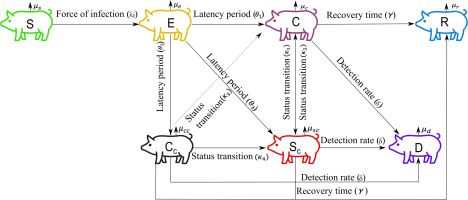
abstract: “The transmission of African swine fever virus (ASFV) within commercial swine barns occurs through both direct and indirect pathways. Identifying and quantifying the specific roles of ASFV dissemination within barns is crucial for developing effective disease control strategies. Researchers developed a stochastic transmission model to examine ASFV dissemination dynamics through eight transmission routes within commercial swine barns, considering seven transmission routes at three disease dynamics levels: within pens, between pens, and within room transmission, along with the transfer of pigs between pens within the same room. The model simulated ASFV spread within barns of various sizes and layouts, with rooms typically having a median of 32 pens, each housing a median of 34 pigs. Simulation results indicated that between-pen transmission pathways contributed most significantly to ASFV spread, accounting for 71.4% of total spread. Among direct transmission pathways, nose-to-nose contact between pens was identified as the primary route of dissemination, comprising an average of 49%, while fecal transmission between pens contributed 21%. Aerosol transmission within pens had the lowest contribution, less than 1%. Furthermore, the daily transfer of pigs between pens did not significantly affect ASFV spread. This research significantly enhances the understanding of ASFV spread within commercial swine production farms in the U.S. and highlights the main transmission pathways that should be prioritized when implementing ASFV countermeasure actions at the room level.”